Howard Harris
Howard Harris’s photography does not seek to freeze the world, but to engage with its inner mobility. Each image is conceived as a space of perception—unstable and sensitive—where what is seen depends as much on light, angle, and distance as on the viewer’s state of mind. Drawing on a background shaped by design and formal thinking, Harris approaches the image as an active construction, capable of transforming through the act of viewing.
Starting from a single photographic capture, he gradually shifts reality toward zones of abstraction, without ever severing its connection to what was observed. An architecture, a body, a fragment of the world becomes a field of chromatic and spatial tensions, crossed by rhythms and lines that seem to reorganize themselves over time.
His work invites the viewer to slow down, to look differently, and to accept that perception is neither fixed nor universal. To look at a work by Howard Harris is to enter into a dialogue in which the image does not impose itself, but reveals itself progressively, through an intimate relationship between material, light, and gaze.
Works presented at Vision’Art
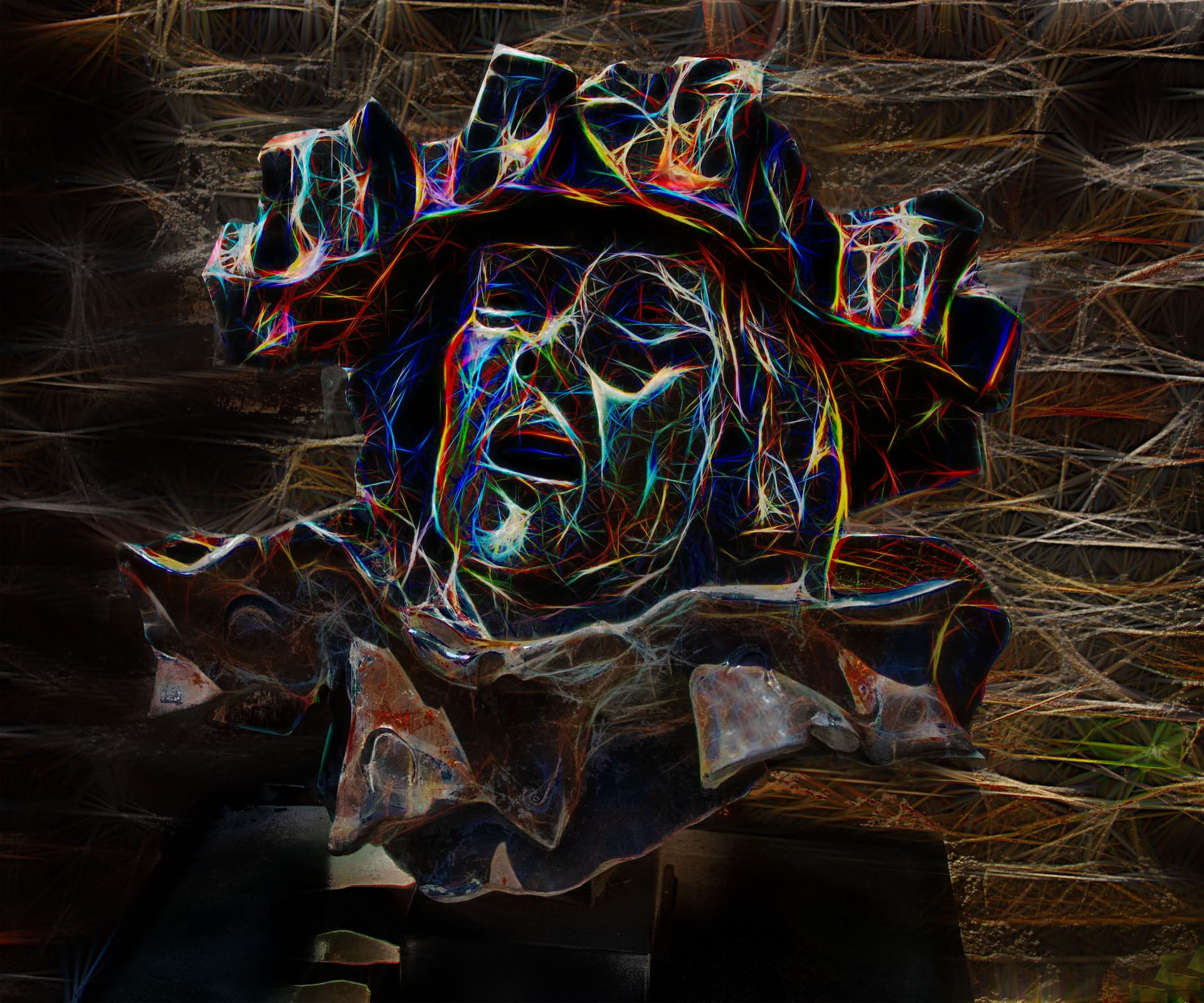
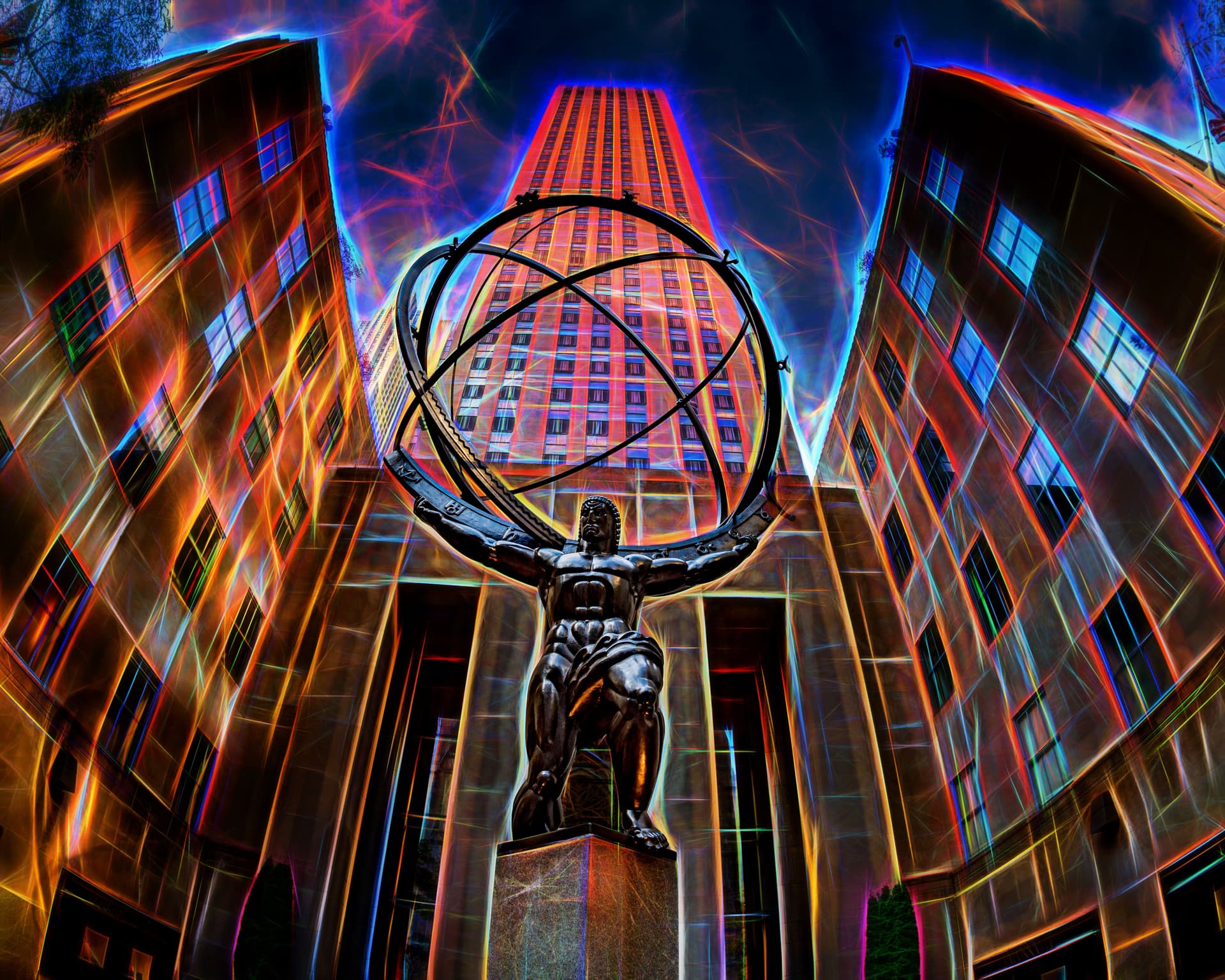
Atlas
Sublimation sur aluminium avec superposition acrylique — 91 × 76 cm — édition 1 sur 5
2021
The works presented here offer a direct insight into Howard Harris’s practice as shown at Vision’Art. Each piece extends his research into perception, light, and the construction of the image as a sensory experience, through works produced on aluminum and enhanced with acrylic overlays.
Prices and availability upon request.
Based in: Denver, United States
Approach: Techspressionism
Mediums: constructed photography; aluminum; acrylic overlays
Howard Harris’s work is structured around a central question: how can the experience of perception itself be made visible? Rather than considering photography as a definitive recording, he approaches it as a point of departure—a preliminary trace meant to be transformed. What interests him is not only what is represented, but the way an image is mentally constructed by the viewer.
His approach is grounded in the idea that all perception is in constant flux, shaped by external parameters—light, space, bodily position—as well as by internal factors that are more difficult to define. In his works, reality is never completely abandoned: it is displaced, fragmented, sometimes pushed to its limits, in order to allow an open visual experience to emerge, one that never fully stabilizes.
From an initial source photograph, Harris engages in a prolonged process of transformation. He analyzes and isolates lines, colors, and forms, then amplifies them or shifts them toward more abstract configurations. This process does not aim for spectacle, but for tension between the constituent elements of the image. The motif becomes a pretext for a broader exploration of visual space and sensation.
Materiality plays an essential role in this research. The images are produced on aluminum and, for certain works, combined with transparent acrylic surfaces organized in layers. This stratified construction introduces a physical dimension: the work never presents itself in the same way depending on the viewing angle or the quality of ambient light. The image appears to reconfigure itself, almost to breathe, as the viewer moves.
Harris’s visual grammar relies on a precise balance between structure and fluidity. Subtle grids, networks of lines, or organized fields of color structure the space without confining it. Color is never decorative; it acts as a force, capable of creating pulsations, zones of tension, or moments of calm. Light, in turn, becomes a true material, modulating depth and intensity within the composition.
This approach gives the works an almost tactile dimension. The viewer is not invited to immediately grasp an identifiable subject, but to move through the image, to linger, and to accept its shifts. The experience unfolds gradually: what initially appears abstract may suddenly suggest a form, a movement, or a memory, before dissolving once again.
For Harris, the meaning of a work is never fixed once and for all. It emerges through the relationship between the object and the viewer. “I believe perception is unique and fluid; each person’s reaction is an integral part of the meaning of the work” (Artist). The image thus becomes a space of projection, where emotion and interpretation are as important as formal construction.
By transforming photography into a perceptual experience, Howard Harris proposes a way of looking that goes beyond the simple recognition of reality. His work invites us to consider the image as a living, unstable phenomenon—and to accept that seeing is, in itself, an act of creation.
Prices and availability upon request — please contact the gallery.
Official website: https://www.hharrisphoto.com
Instagram: https://www.instagram.com/howardharrisphotoart
Subscribe to our newsletter to be the first to discover our events, exhibitions, artists, and much more