Linda Koopman
Linda Christina Koopman’s work is rooted in a patient attention to landscape and to what it retains of human history, even in the absence of any visible figure. Her photographs engage with territories shaped by centuries of intervention, where the organization of land, lines of separation, ditches, canals, and boundaries reveal a continuous relationship between people and their environment. Nothing here is spectacular or anecdotal; the image unfolds within a slow, attentive, almost silent temporality.
Trained in photography and monumental textiles, and later informed by an anthropological approach to material culture, Linda Christina Koopman develops a practice that questions how landscapes are constructed, transformed, and transmitted over time. Photography becomes both a tool of observation and a form of reading: each recorded detail acts as a trace, an indicator of use, constraint, or adaptation.
Her images invite the viewer to slow down, to consider what remains embedded in a field, a wall, or a horizon line — the memory of gestures carried out long ago. The landscape is never fixed; it appears as a living structure, shaped by time, seasons, and human necessity.
Works at Vision’Art
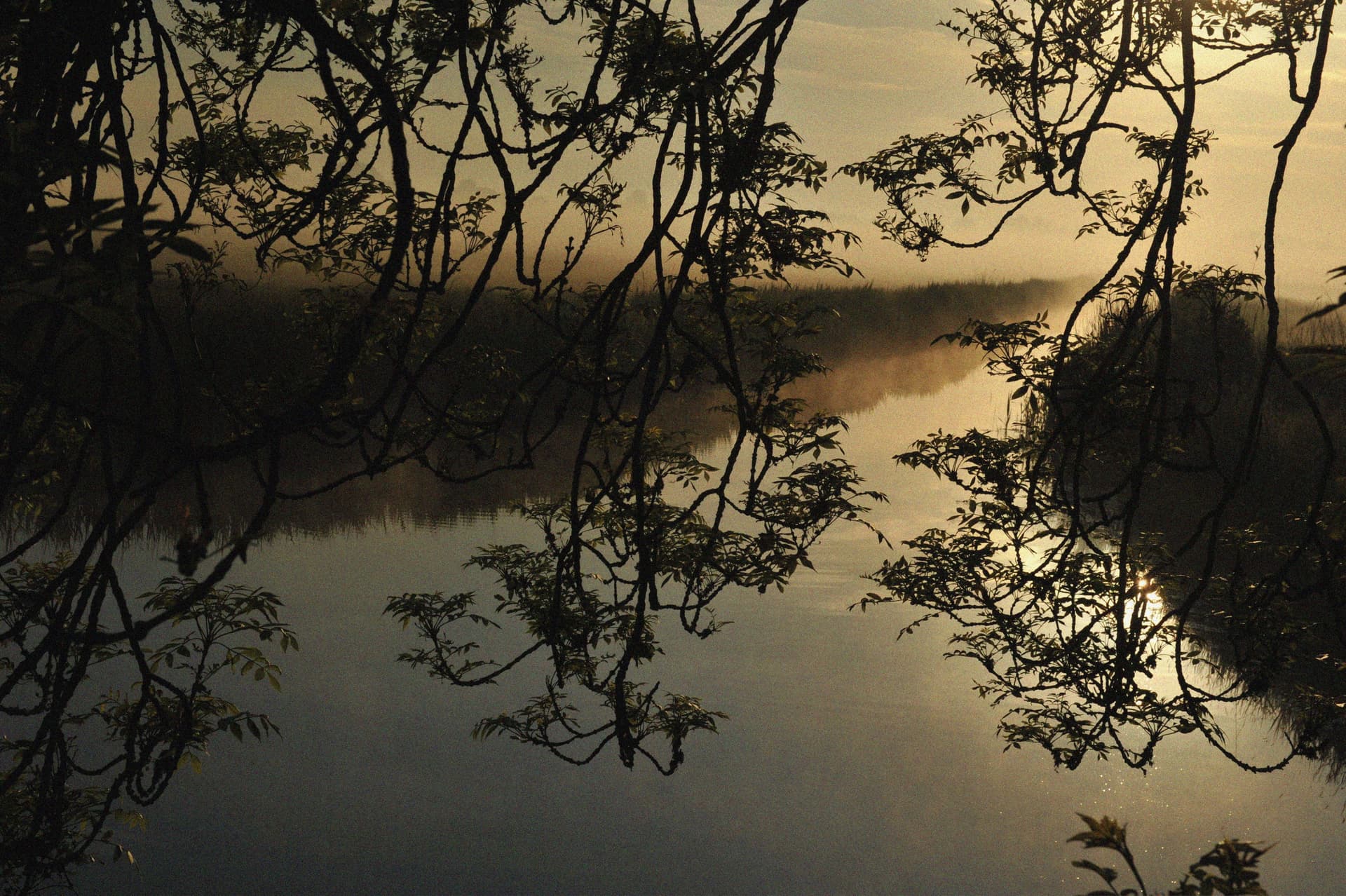
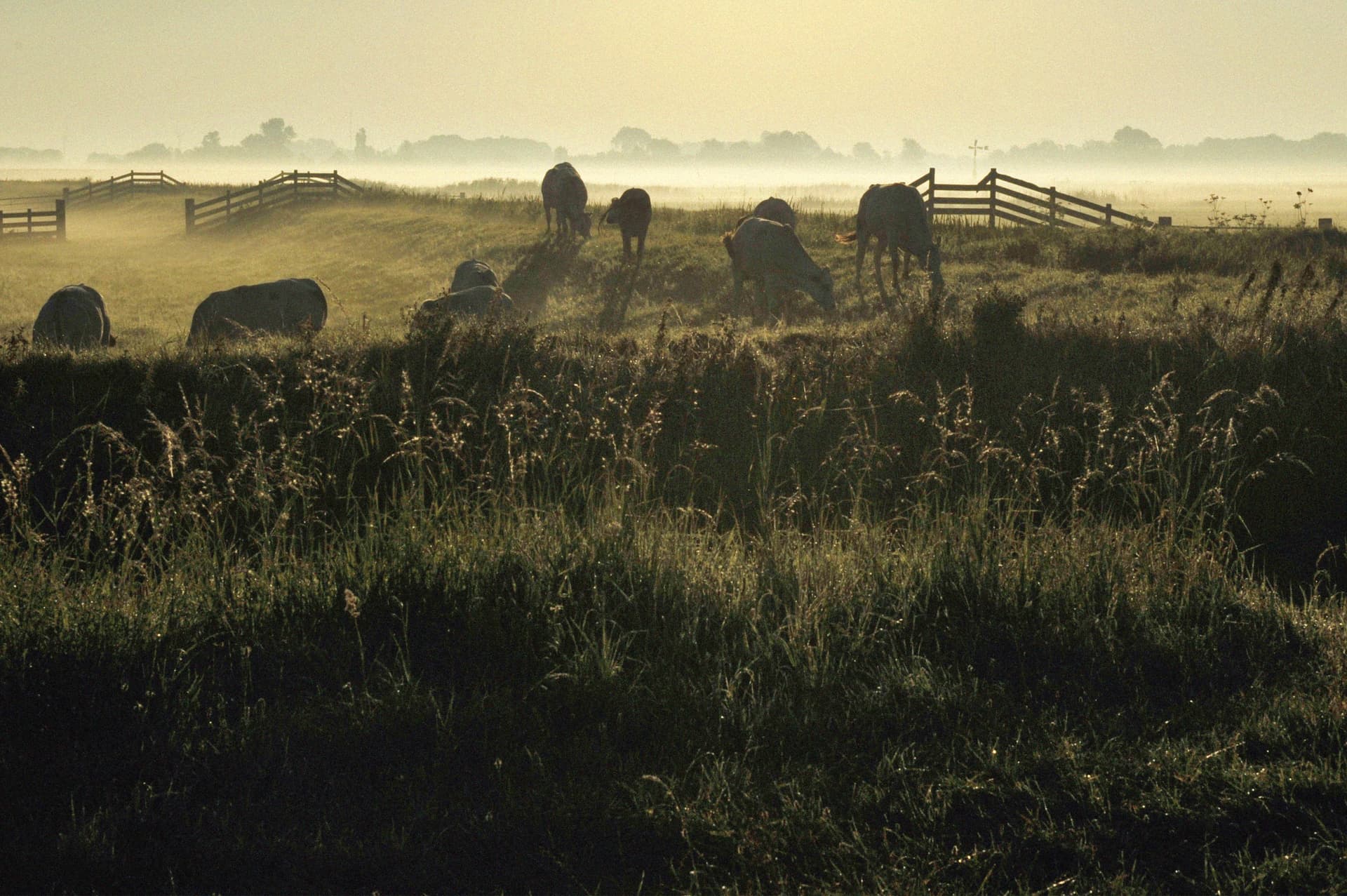
Banscheiding tussen Bergen en Schoorl, Netherlands
Photographie numérique — 30 × 40 cm — Édition 3 (S, M, L) + 2 AP
2020
Based in the Netherlands
Approach: an exploration of landscape as a historical and cultural construction
Media: analogue and digital photography
Education: Gerrit Rietveld Academie, Amsterdam
Linda Christina Koopman’s approach is grounded in a simple and persistent question: how did an apparently ordinary landscape come to take on this exact form? This question runs through her entire photographic practice and guides her choice of subjects. The territories she photographs are not considered as backdrops, but as historical constructions—shaped by an ongoing interaction between natural constraints and human responses.
During her studies at the Gerrit Rietveld Academie, photography gradually entered into dialogue with her visual research. Observing details—cut reeds, fence structures, old walls, fields after harvest—feeds both the image and other visual forms. This attention to modest elements, often overlooked, forms the foundation of her photographic language.
The landscape is approached through fragments and discreet signs, rather than through a panoramic or demonstrative view.
Her interest in cultural anthropology, and more specifically material culture, strengthens this approach. Her photographic projects often unfold as long-term research: consulting old maps, exploring archives, reading documents related to land planning, and speaking with local residents. These elements are never illustrated literally in the image, but they structure the way she looks in the field.
Photography thus becomes an extension of the inquiry—a sensitive way of making visible what has been shaped by necessity: land drainage, dikes, canals, mills, dams, and water-protection systems.
Although the human figure is absent from her images, human presence is perceptible everywhere. The photographed landscapes bear the marks of past and present decisions; they testify to a constant adaptation to an environment that can sometimes be hostile. Linda Christina Koopman seeks to show these traces without dramatising them, leaving the viewer free to interpret them. The image does not aim to explain, but to suggest—to open a space for reflection.
The relationship to time is central in her work. Variations in light, changes of season, and weather conditions profoundly alter the appearance of a single place. This visual instability encourages regular returns to the sites she photographs, as if each visit revealed a new layer of the landscape. Photography is not a definitive act; it belongs to an attentive repetition, almost meditative.
Formally, her visual language is characterised by rigorous composition and a fine attention to textures. Lines, rhythms, and surfaces structure the image without ever confining it. Whether she works with analogue or digital photography, the aim remains the same: to convey a silent presence, a density that goes beyond the simple recording of reality. The material of the ground, the roughness of a wall, or the softness of a field become narrative elements in their own right.
The experience offered to the viewer is one of subtle displacement. In front of the images, time seems to pause; the eye is invited to move slowly, to linger on details that might otherwise go unnoticed. One sentence from the artist sums up this posture with simplicity: “The more you know the more you see”. Here, knowledge is not academic learning, but an availability of the gaze—an ability to perceive what reveals itself gradually.
Prices and availability on request — please contact the gallery.
Links (as displayed):
https://www.lindakoopman.nl
https://www.itsliquid.com/interview-lindakoopman.html
https://aatonau.com/linda-koopman-the-artistic-alchemy-of-photography/
Subscribe to our newsletter to be the first to discover our events, exhibitions, artists, and much more